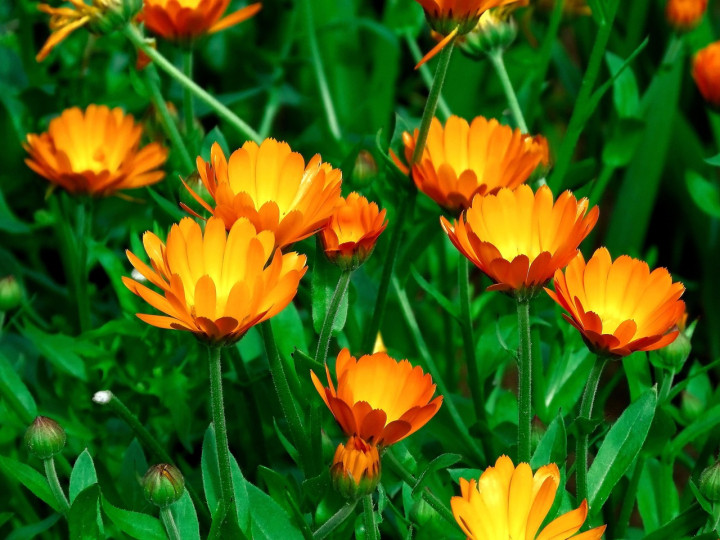
Calendula

Calendula officinalis

Calendula

🌼 Calendula (Calendula officinalis)

A bright, resinous, antioxidant‑rich Asteraceae herb renowned for wound healing, skin repair, inflammation modulation, and gentle lymphatic support.

🌱 Botanical Snapshot

  • Family: Asteraceae
  • Type: Annual or short‑lived perennial
  • Height: 30–60 cm
  • Leaves: Spatulate to oblong, slightly sticky, aromatic
  • Flowers: Bright yellow to deep orange daisy‑like heads
  • Origin: Mediterranean; now cultivated worldwide

Sources:
International Journal of Pharmaceutical Sciences review (2024)
IJPRA comprehensive review (2025)

🧪 Key Phytochemicals

Calendula is chemically dense, containing:
- Flavonoids

  • Quercetin
  • Isoquercetin
  • Rutin
  • Isorhamnetin
    - Triterpenoids & Triterpene Alcohols
  • Oleanolic acid
  • Stigmasterol
  • Triterpeneol esters
    - Carotenoids
  • Lutein
  • Flavoxanthin
  • Rubixanthin
  • β‑carotene
  • Lycopene
    - Other Constituents
  • Saponins
  • Coumarins
  • Quinones (plastoquinone, phylloquinone, tocopherol, ubiquinone)
  • Essential oils
  • Amino acids (15 identified across plant parts)

Sources:

IJPS phytochemistry review (2024)
IJPRA review (2025)
Comprehensive medicinal review (2024)

💚 Evidence‑Supported Benefits

  1. Wound Healing & Skin Repair
    Calendula is one of the most researched topical herbs for:
  • Cuts, scrapes, abrasions
  • Burns
  • Dermatitis
  • Post‑surgical healing
  • Radiation‑related skin irritation
    Mechanisms include:
  • Increased collagen synthesis
  • Enhanced epithelialization
  • Antimicrobial protection

Sources:
IJPS review – wound healing, tissue repair, burn support
IJPRA review – skin injuries, mucosal healing

  1. Anti‑Inflammatory Activity
    Calendula reduces inflammatory markers and inhibits lipoxygenase.
    Useful for:
  1. Antimicrobial & Antifungal Effects
    Extracts show activity against:
  • Staphylococcus aureus
  • E. coli
  • Candida albicans
  • Aspergillus niger
  • Methanol extracts often outperform ethanol extracts.

Sources:
IJPS review – antimicrobial spectrum
IJPRA review – antibacterial & antifungal activity

  1. Antioxidant & Photoprotective Effects
    Calendula scavenges hydroxyl and superoxide radicals and protects lipids from peroxidation.

Sources:
IJPRA review – antioxidative activity in liposomal models
IJPS review – carotenoid‑driven antioxidant effects

  1. Lymphatic & Circulatory Support
    Calendula promotes lymphatic flow and toxin clearance, making it useful for:
  • Swelling
  • Congestion
  • Slow‑healing tissues

Source:
IJPS review – lymphatic circulation enhancement

  1. GI & Gynecological Support
    Traditionally used for:
  • Gastritis
  • Ulcers
  • Dysmenorrhea
  • Uterine congestion

Sources:
IJPRA review – GI, gynecological, and mucosal uses
Medicinal review – internal uses for spasms, ulcers, mucosal inflammation

Benefits

  • Wound Healing & Skin Repair
  • Anti‑Inflammatory Activity
  • Antimicrobial & Antifungal Effects
  • Antioxidant & Photoprotective Effects
  • Lymphatic & Circulatory Support
  • GI & Gynecological Support